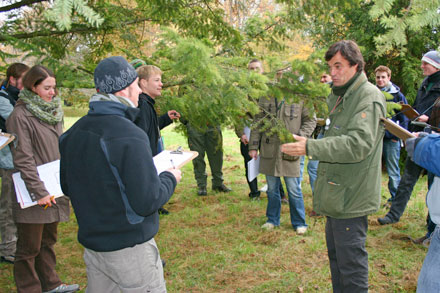
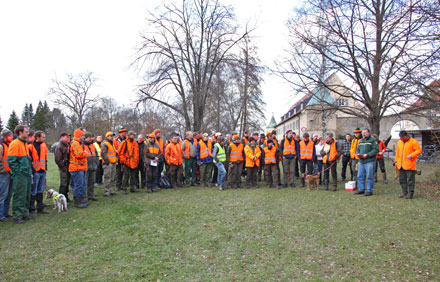
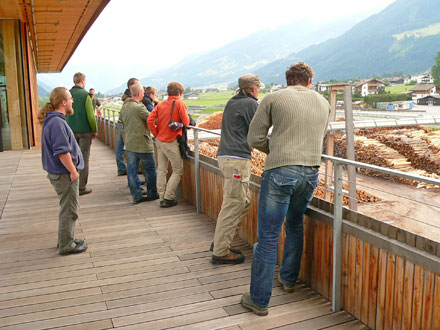
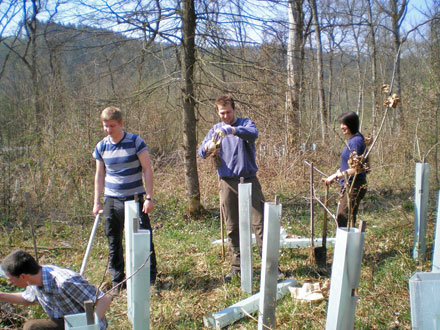
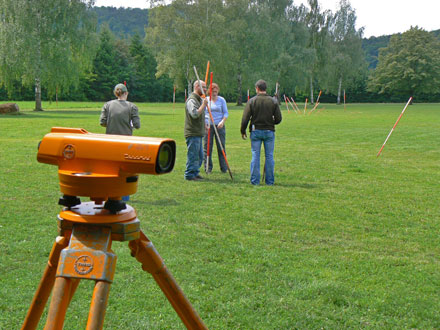
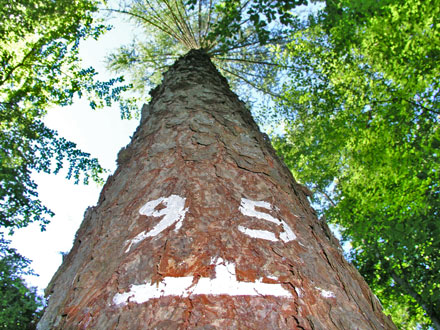
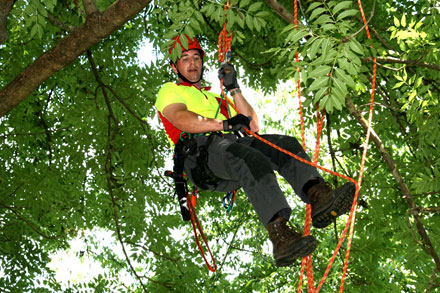
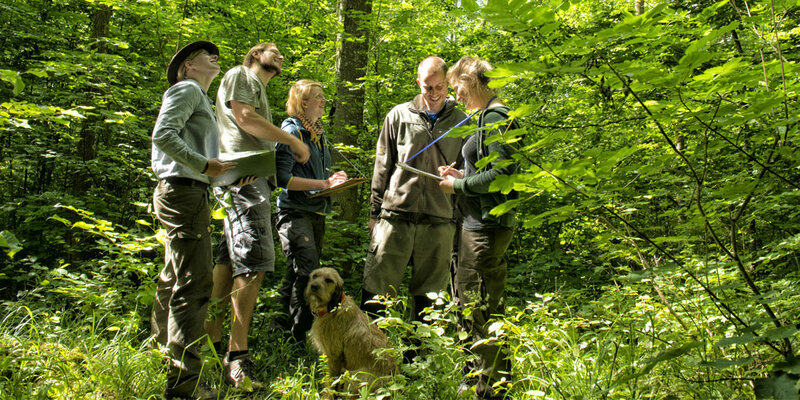
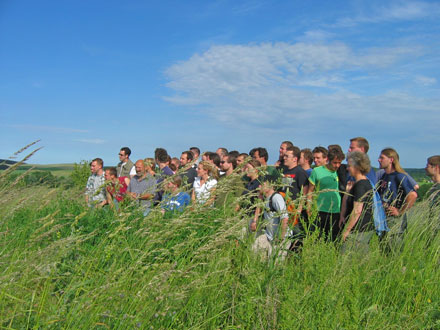
• Eine Gruppe Studierende bei einer praktischen Waldbauübung im Lehrwald der Hochschule Rottenburg

    B.Sc. Forest Management

    Studying Forest Management is something for conservationists and designers, in short, for doers.

"... with probably the clearest forestry profile of all higher education institutions in Germany" (UNESCO Commission)

Forest Management (Bachelor of Science)

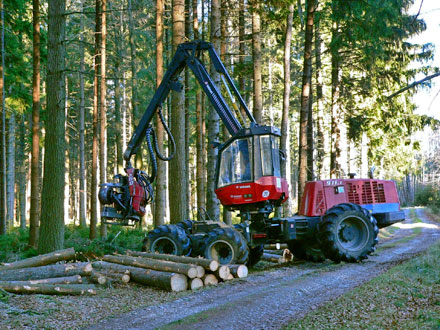
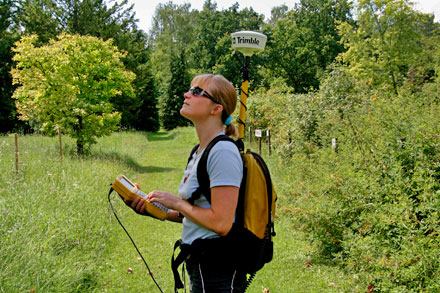
The forestry and timber industry is of great importance to society, as studies and current environmental debates show. It opens up a wide range of career prospects for specialists in this highly topical field. The School of Applied Sciences Rottenburg attaches particular importance to its high practical relevance, which it ensures through the use of numerous lecturers, its integrated practical semester and the on-site teaching area. Throughout the degree programme, some of the courses take the form of excursions, practical exercises and project and group work. The 2,500-hectare teaching area right on the doorstep offers ideal practice opportunities for this.

In the first two semesters, students learn the basics of the broad-based forestry degree programme. In addition to natural, social, technical and methodological sciences, great emphasis is placed on the acquisition of key qualifications. In the main study programme, the subject areas of forestry are jointly deepened and supplemented. Individual specialisation is possible from the 5th semester (practical semester). In the 6th and 7th semesters, two modules must be chosen from 14 different options. In this way, students can create their own profile through various possible combinations.

At a Glance
Ausgezeichnet Logo Hochschule für Forstwirtschaft Rottenburg Logo UNESCO-2014 Hochschule für Forstwirtschaft Rottenburg
Duration of Study

7 semesters (6 theory semesters with numerous exercises and field trips, and 1 practical semester)

Start Date

dmission to the first semester takes place once a year, at the start of the winter semester.

Degree

Bachelor of Science (B.Sc.)

Practical Semester

In the fifth semester

Language of Instruction

German

ELECTIVE-COMPULSORY MODULES

In the 6th and 7th semesters, students may select two elective-compulsory modules each and combine them freely. Please refer to the next tab, “Program Structure,” or the module handbook for details on the various modules.

Practical Experience

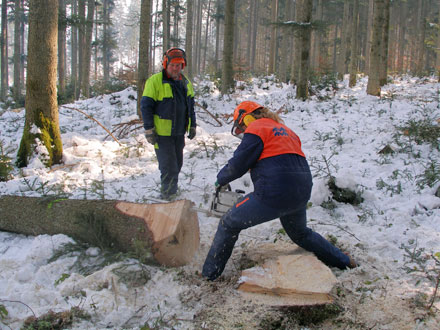
The program places great emphasis on practical relevance in student training. This is achieved through a high proportion of field trips in Germany and abroad, practical exercises in the university’s own teaching and experimental forest, and practice-oriented team and project work with partners from industry and public administration. As a result, students become familiar with the demands of professional practice at an early stage.

ELECTIVE COURSES

Elective courses and the development of key competencies through specially designed courses help round out each student’s individual profile.

Study programme

1st foundation course (1st & 2nd semester) moreless

During the foundation year (1st and 2nd semesters), students are systematically taught a broad range of fundamental knowledge that they will need for the rest of their degree. The modules in the foundation year are:

  • Zoology, Wildlife Biology and Wildlife Ecology
  • Timber Utilisation/Timber Grading
  • Introduction to Forestry Economics
  • Scientific Methods and Key Skills
  • Botany and Fundamentals of Silviculture
  • Fundamentals of Geosciences
  • Wildlife Management
  • Fundamentals of Forestry Work
  • Cartography and Forest Inventory
  • Forest Protection 1

Please refer to the module handbook for details of the individual courses within the modules

2nd main study programme (3rd & 4th semester) moreless

The first part of the main course (3rd and 4th semesters) provides students with intensive preparation for the practical placement and their future careers. The modules in the main course are:

  • GIS Fundamentals
  • Wood Utilisation
  • Site, Tree Species, Climate Change
  • Forest Protection 2
  • Environment and Society
  • Forestry Work and Forestry Technology
  • Forest Engineering
  • Forest Management and Accounting
  • Forest Education
  •  Forests and Society

Please refer to the module handbook for details of the individual courses within the modules.

3rd practical semester (5th semester) moreless

During the work placement semester (5th semester), which can be undertaken either in Germany or abroad, students have the opportunity to apply their knowledge in a business setting and take on tasks and responsibilities. This is often where they make their first contacts with future employers.

4th main study programme (6th & 7th semester) moreless

In the second part of the main course of study (6th and 7th semesters), students must select two modules per semester from a choice of 14 different options. This allows students to create their own profile through a variety of possible combinations.

6th semester:

  • Municipal services and green space management
  • Forest management
  • GIS applications
  • Nature conservation and landscape management
  • Life Cycle Assessment and Ecosystems
  • Wildlife Management
  • Digitalised Timber Supply Chain Services

7th semester:

  • Soil Management
  • GIS Analyses
  • Arboriculture and Nursery Operations
  • People and the Environment
  • Management and the Timber Industry
  • Agri-ecology and Regional Economics
  • Practical Project: Forest Management Planning

Modules that all students must complete are:

  • Forest Management Planning
  • Forest Road Construction
  • Land use policy
  • Seminar: Communication for future managers
  • Silvicultural systems
  • Timber supply

Through the specialisation offered by the freely combinable compulsory elective modules, graduates are additionally qualified for management and consultancy roles in forestry, the timber and sawmill industry, and nature and environmental conservation.
Ablaufschema Studiengang B.Sc. Forstwirtschaft
Career fields

Our bachelor graduates take on advanced leadership roles in:

  • state, municipal, or private forestry enterprises, e.g., in the upper forestry service (forest ranger)
  • forestry service companies
  • the sawmill and wood industry
  • medium-sized companies in related sectors
  • spatial and landscape planning, nature and environmental protection
  • international development cooperation
  • rural development (development tasks)
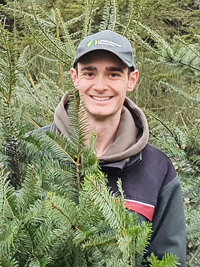
Absolvent Forstwirtschaft Noah Weinbrecht

Noah Weinbrecht (B.Sc. Forest Management) 
works today as a district forest manager (Revierleiter) at Landesforsten Rhineland-Palatinate.

Since 2021, a cooperative program between the university and Landesforsten Rhineland-Palatinate has offered the qualification for the upper forestry service in parallel with the degree program. As a combined student of the first cohort, Noah Weinbrecht was able to obtain his bachelor’s degree and complete the civil service career examination within four years. After successfully passing the exam, he was appointed as a civil servant.

The instructive practical phases at the Boppard Forest Office complemented his studies in Rottenburg and enabled a smooth transition into professional life. His first position was managing a forest district in the Rheinhessen Forest Office. Due to the region’s low forest cover, the tasks are very diverse. In addition to advising municipalities, nature conservation, traffic safety, forest conversion, and public relations are important areas of responsibility.

The elective modules in the degree program allowed for individual specialization in current topics such as ecosystem services of forests. Optimal preparation was provided both by the practice-oriented studies in Rottenburg and by the continuous learning experience with a dedicated training forester in Rhineland-Palatinate.

Absolventin Forstwirtschaft - Lisa Weiß

Lisa Weiß
The diverse range of courses in the Bachelor of Forest Mangement at HFR made it possible to explore one’s individual interests. Some of my fellow students discovered their passion for nature conservation, forest education, GIS, nursery operations, or silviculture.

I realized that I kept returning to the same questions: What are the limits of the technical usability of wood? How can an economy striving for sustainability make meaningful use of old and residual wood? What utilization options exist for wood that is increasingly accumulating in German forests due to climate change?

I found researchers working on these and many other questions at the University of Natural Resources and Life Sciences (BOKU) in Vienna. In the master’s program Wood Technology and Management, wood is examined not only macroscopically, as in timber construction, but also down to the molecular level. In this international and interdisciplinary environment, the seemingly endless possibilities of using wood and wood products as technical materials become visible—possibilities we have so far used only to a limited extent.

Although my practice-oriented bachelor’s degree meant the challenge of adapting to a very differently thinking academic environment, I am grateful for the holistic perspective it gave me on material cycles in the forestry and wood industry.

My studies enable me to contribute to making one of our forest’s great potentials—wood—usable in highly technical applications.

Absolventin Forstwirtschaft Jana Niedermayer

Jana Niedermayer
After completing her B.Sc. in Forest Management in Rottenburg with a specialization in Geographic Information Systems and Landscape Management, she pursued a master’s degree in Environmental Sciences (specialization: Land Use and Nature Conservation) at the University of Freiburg. Since 2021, she has been working as a research associate at the NABU Forest Institute (formerly Institute for Landscape Ecology and Nature Conservation, ILN) in Bühl.
Her tasks are diverse and varied: in addition to ecological project support for testing nature conservation–optimized maintenance of Rhine flood protection dikes, she also manages a forest grazing project, prepares biotope network planning for several municipalities, and is involved in a scientific research project at the Karlsruhe Institute of Technology (KIT) on biodiversity and water management (BioWaWi). In the future, the focus will increasingly shift toward forest-related projects, as the institute intends to expand its research in this area. The forest Management degree at HFR thus laid the foundation for a versatile career by opening up new and exciting fields of interest.

LORENZ HAUSCH

Lorenz Hausch (B.Sc. Forest Management)
with a specialization in “Forest and Municipal Management,” works today as a district forest manager at Blauwald GmbH & Co. KG.

Since being hired after graduation, Lorenz Hausch has been responsible for managing a forest district. This work is varied and extensive. His professional responsibilities include planning, organizing, and carrying out timber harvesting, young stand tending, forest regeneration, hunting, road maintenance, as well as supervising and guiding the forest workers and contractors in the district.

The practice-oriented training at the university in Rottenburg, combined with the experience gained during internships in various forestry enterprises, enabled Lorenz Hausch to enter the profession directly as a district manager in a private forestry company.

MIRIAM LANGENBUCHER

Miriam Langenbucher
Bachelor of Applied Forest Sciences / Engineer (FH), with a focus on General Forestry, now works as the manager of the newly developing Steigerwald Treetop Walk in Bavaria.
After her studies, she completed the forestry inspector trainee year at the Soonwald Forest Office with Landesforsten Rhineland-Palatinate and was appointed to the state service after passing the state examination. After two years in controlling within the state forestry administration, she moved to the Bavarian State Forests into her current position.
Once the project phase is completed, she will take over the operational management of the treetop walk and will be responsible for staff leadership, planning, budgeting, and, for example, traffic safety. The position allows her to apply forestry expertise while also gaining insight into entirely different fields.

Interview with Simone Eckermann

Interview with Verena Strasdeit

Interview with Leonie Münzer

How to Apply

Admission to this program is limited; that is, there are 92 spots available for the Forest Management program.

You can find more information about the application process here.

Further Information

You can find more information about the B.Sc. in Forest Management program here.