Dealing with water as a resource requires project-orientated, multifunctional and interdisciplinary skills in both industrialised and developing countries.
Water Resource Management (Bachelor of Science)
Water is one of the most essential resources for human life. Neither our existence nor agriculture, energy production, or industrial and commercial activities are possible without it. Ensuring sufficient water resources and managing them sustainably and responsibly is more crucial than ever for the survival of human society, particularly in light of global population growth and climate change.
The highly topical field of "water resource management" requires an interdisciplinary approach and a wide range of skills. The degree programme not only teaches these interdisciplinary skills but also provides sound methodological knowledge in order to successfully plan and implement integrated water resource management in a national and international environment. In addition to scientific and technical principles, social science aspects are also of great importance. Securing the global supply and disposal of water constantly requires new solutions, as the social and technical framework conditions are changing rapidly. The involvement of national and international partners from science, business, politics, planning and non-governmental organisations guarantees an ongoing transfer of knowledge, a high level of practical relevance and the topicality of the issues dealt with.
The seven-semester degree programme lays the necessary foundations in the first two semesters in order to deepen relevant subject areas in the two-part main course. The strong practical orientation is ensured by the practical semester.
Students can gain international experience both during an internship semester and as part of a semester abroad at one of the partner universities. The internship semester positions of previous students now cover all continents outside Germany. Contacts with foreign universities have so far been established within Europe, in California, Venezuela and Burundi. Further cooperations are in preparation.
7 semesters (6 semesters at HFR with numerous exercises, field trips, group and project work, plus 1 practical semester)
Start
Admission to the first semester takes place once a year, in the winter semester.
Degree Awarded
Bachelor of Science (B.Sc.)
Practical Semester
In the fifth semester
Language of Instruction
German
Specializations
None
Practical Orientation
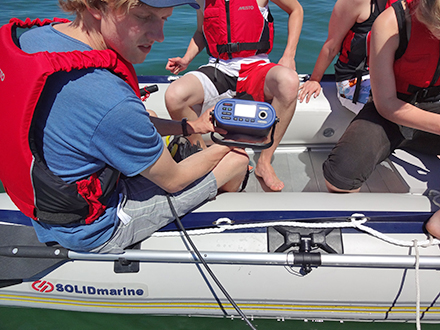
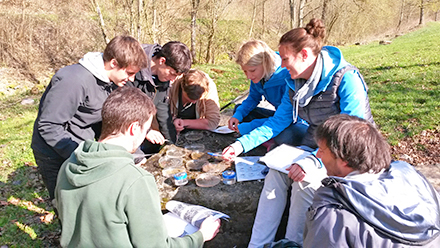
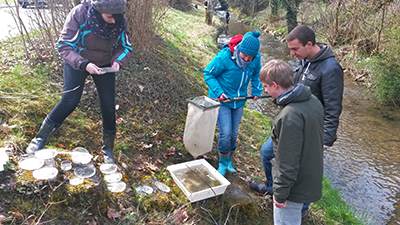
Great emphasis is placed on practical training. This is ensured through practice oriented course content, the involvement of experienced guest lecturers, numerous field trips and excursions in Germany and abroad, outdoor and laboratory exercises, as well as practice based team and project work (e.g., the integrative project in the 4th semester and the practical semester). Through cooperation with partners from industry, public administration, and governmental agencies, students become familiar with professional requirements early on.
Elective Modules
A wide range of elective modules allows students to develop an individual academic profile.
The Water Resource Management degree programme comprises a total of seven semesters and is divided into a two-semester foundation course and a four-semester main course, which is interrupted by the integrated practical semester in the fifth semester. The programme concludes with the completion of the bachelor’s thesis.
In addition to the compulsory courses, which are mandatory for all students, individual specialisations can be set in the higher semesters via the so-called compulsory electives.
1st foundation course (1st & 2nd semester)
moreless
In the foundation course (1st & 2nd semester), students are systematically taught a broad basic knowledge that forms a relevant basis for the main course.
The courses in the basic study programme are:
Human Geography and Global Change 1
Climatology
Fundamentals of business administration and economics
Sustainability
Chemistry
Water chemistry methods course
Mathematics 1 – Analysis and Linear Algebra
Mathematics 2 – Statistics/Stochastics
(Inter-) national aspects of water management
Moderation, mediation, participation
IT basics
Scientific work
Geography and Global Change 2
Climate change
Nature conservation
Vegetation ecology
Zoology
Soil science
Geology
Geomorphology
Hydrology
Hydrological methods course
Limnology
Limnology methods course
Tourism and water
Water education
2nd main study programme (3rd & 4th semester)
moreless
The first part of the main study programme (3rd & 4th semesters) prepares students intensively for the practical semester and the subsequent second part of the main study programme.
The courses of the main study programme are:
Urban water management 1
Pipe and pipe systems, system planning, system management
Aquatic ecotoxicology
Fundamentals of fluid mechanics
Hydropower and the energy industry
Forestry and agricultural land-use systems
Waste management
Development cooperation
Intercultural competence and international consulting
The practical semester (5th semester) not only offers the opportunity to apply the knowledge you have learned at companies, authorities, or organisations in Germany or abroad, but also the chance to gain initial professional experience, make contacts with potential employers, and possibly even do some preparatory work for your Bachelor's thesis.
The length of the internship semester makes it possible to be integrated into projects and take on responsibility but also to split the semester into two shorter partial internships and thus gain experience in two different subject areas or regions.
4th main study programme (6th & 7th semester)
moreless
The second part of the main study programme (6th and 7th semesters) prepares students for professional practice or, if applicable, for a subsequent master’s degree programme. The programme concludes with the bachelor’s thesis.
The courses in the last part of the main study programme are:
General and applied hydrogeology
Microbiology
Applied environmental analysis
Flood and heavy rainfall management
Engineering hydrology
Project practice 1
Project management
Water-specific challenges in developing countries
Drought and low water management
Organisational development and change management, leadership, business coaching
The seven semester bachelor’s program Water Resource Management (B.Sc.) consists of six semesters at HFR and one integrated practical semester.
Key Features of the Water Resource Management Program at HFR:
Interdisciplinary approach through the integration of natural sciences, engineering, and social sciences
Continuous cross linking of content to illustrate the close connections between economic, ecological, technical, scientific, and social fields of action in the water sector
Inclusion of key qualifications to develop methodological skills in moderation and participation processes, as well as data processing and IT fundamentals
Strong practical orientation through practice oriented teaching content and formats, as well as the practical semester
Opportunity for individual specialization through a wide range of elective modules
Graduates of HFR have excellent career prospects in various sectors and are often employed at interfaces within companies and institutions where transdisciplinary questions related to water resource management are addressed.
Graduates of the bachelor’s program Water Resource Management find employment opportunities in the following sectors and institutions:
Nature conservation (e.g., river restoration, wetland management)
Environmental protection (e.g., flood risk management, water quality protection)
Sustainable tourism (e.g., water based tourism, post mining landscape development)
Development cooperation (e.g., water supply and sanitation challenges, sustainable water resource use)
Policy consulting, consulting, and regional/landscape planning with a water related focus
Urban water management and industrial water management
Public administration (authorities with water related responsibilities, e.g., municipal utilities, environmental agencies)
Alternatively, a wide range of master’s programs in Germany and abroad offer opportunities for further qualification and specialization.
Career Perspectives
Graduates who entered the workforce directly after completing the bachelor’s program have taken on roles in:
Flood‑risk management
Expansion of renewable energy systems
Construction and operation of wastewater treatment facilities
Engineering consultancies
Municipal utilities
Employers particularly value the interdisciplinary training of graduates, which enables them to address sustainable water resource management across disciplinary boundaries. The program’s strong practical orientation and close cooperation with water‑sector professionals ensure a labor‑market‑oriented, hands‑on education aligned with current research.
Graduate Profiles
Berufsportraits von Absolventinnen - Interview mit Rebecca Orschler
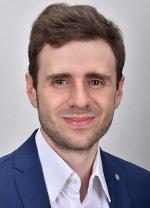
My name is Björn Loos. From 2014 to 2018, I studied Water Resource Management at the University of Applied Forest Sciences in Rottenburg. At the beginning, I was unsure whether I had chosen the right program, but the broad and interdisciplinary content quickly convinced me, and I am glad I stayed. After completing my bachelor’s degree, I began a master’s program in Environmental Protection at Nürtingen-Geislingen University (HfWU), specializing in urban water management and industrial wastewater treatment. The program is a cooperation between HfWU, Reutlingen University, Esslingen University, and Stuttgart University of Applied Sciences.
During my studies, I completed several internships to find out which professional field suited me best. In the end, things turned out differently than expected: due to the COVID 19 pandemic in 2020, my master’s graduation and job search were challenging, and I eventually joined the Ludwigsburg District Office in the field of municipal wastewater and water bodies.
Looking back, this was the right decision. The work is diverse and far from boring. My colleague and I oversee 28 wastewater treatment plants and 380 stormwater overflow structures. Exciting projects include new housing developments, treatment plant expansions, and the construction of advanced micropollutant removal systems. Through this broad range of tasks, I came into contact with many other fields and eventually found a new role: since mid 2023, I have been the operations manager of Tübingen’s municipal wastewater services and look forward to the new challenge.
I’m Vanessa, and I completed my bachelor’s degree in Water Resource Management in Rottenburg from 2016 to 2020. During my six month practical semester, I gained valuable experience at the Regional Council in Tübingen. I was particularly interested in geoinformatics, which led me to pursue a master’s degree in Physical Geography in Tübingen, focusing on GIS and remote sensing. Throughout both degrees, I became increasingly fascinated by the use of drones in water related applications. During my master’s studies, I worked as an intern and student assistant at I AM HYDRO GmbH, a company specializing in drone based surveying and monitoring of water bodies.
After completing my master’s degree, I was hired permanently at I AM HYDRO. I now work in fish monitoring, river surveying, and consulting. I especially enjoy the variety of the job: we regularly work outdoors, surveying rivers or installing and maintaining camera systems for fish monitoring. We also have international projects—one highlight was spending three weeks in Indonesia to survey a river.
My name is Matthias Engelfried, and I was part of the first cohort of the Water Resource Management program, starting in the winter semester of 2013. Afterward, I pursued a master’s degree in Civil Engineering at Karlsruhe University of Applied Sciences, specializing in water management. In addition to courses in construction management, construction law, and mathematics, the engineering fundamentals from the bachelor’s program—such as hydraulics, numerical flow modeling, hydro infrastructure, and urban water management—were deepened.
Alongside my master’s studies, I gained practical experience at RBS wave GmbH in the consulting department, first as an intern and later as a student assistant. I am now employed there as a project manager in the network management team. Our work includes analysis, condition assessment, asset preservation, safety, and optimization of existing networks and facilities, as well as the development of customized solutions. I work on these topics through pipeline network analyses and calculations using the STANET software for both public water suppliers and industrial clients.
Through the team’s close cooperation with students during internships and thesis projects, I still regularly meet “Rottenburg water managers” in my daily work.
![[Translate to English:] Studierende des Studiengangs Ressourcenmanagement Wasser sitzen im Innenhof an Tischen und unterhalten sich](/fileadmin/_processed_/8/f/csm_wasser_slider_video_f794de09b6.jpg "Video Portrait")