- from the enrolment year 2019/2020
-
Study programme from the enrolment year 2019/2020
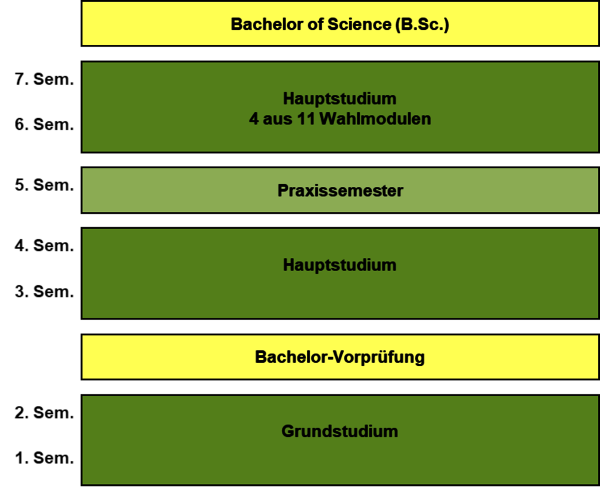
1st foundation course (1st & 2nd semester) moreless
During the foundation year (1st and 2nd semesters), students are systematically taught a broad range of fundamental knowledge that they will need for the rest of their degree. The modules in the foundation year are:
- Zoology, Wildlife Biology and Wildlife Ecology
- Timber Utilisation/Timber Grading
- Introduction to Forestry Economics
- Scientific Methods and Key Skills
- Botany and Fundamentals of Silviculture
- Fundamentals of Geosciences
- Wildlife Management
- Fundamentals of Forestry Work
- Cartography and Forest Inventory
- Forest Protection 1
Please refer to the module handbook for details of the individual courses within the modules
2nd main study programme (3rd & 4th semester) moreless
The first part of the main course (3rd and 4th semesters) provides students with intensive preparation for the practical placement and their future careers. The modules in the main course are:
- GIS Fundamentals
- Wood Utilisation
- Site, Tree Species, Climate Change
- Forest Protection 2
- Environment and Society
- Forestry Work and Forestry Technology
- Forest Engineering
- Forest Management and Accounting
- Forest Education
- Forests and Society
Please refer to the module handbook for details of the individual courses within the modules.
3rd practical semester (5th semester) moreless
During the work placement semester (5th semester), which can be undertaken either in Germany or abroad, students have the opportunity to apply their knowledge in a business setting and take on tasks and responsibilities. This is often where they make their first contacts with future employers.
4th main study programme (6th & 7th semester) moreless
In the second part of the main course of study (6th and 7th semesters), students must select two modules per semester from a choice of 14 different options. This allows students to create their own profile through a variety of possible combinations.
6th semester:
- Municipal services and green space management
- Forest management
- GIS applications
- Nature conservation and landscape management
- Life Cycle Assessment and Ecosystems
- Wildlife Management
- Digitalised Timber Supply Chain Services
7th semester:
- Soil Management
- GIS Analyses
- Arboriculture and Nursery Operations
- People and the Environment
- Management and the Timber Industry
- Agri-ecology and Regional Economics
- Practical Project: Forest Management Planning
Modules that all students must complete are:
- Forest Management Planning
- Forest Road Construction
- Land use policy
- Seminar: Communication for future managers
- Silvicultural systems
- Timber supply
Through the specialisation offered by the freely combinable compulsory elective modules, graduates are additionally qualified for management and consultancy roles in forestry, the timber and sawmill industry, and nature and environmental conservation.
- until the enrolment year 2018/2019
-
Study programme until the enrolment year 2018/2019
1st foundation course (1st & 2nd semester) moreless
During the foundation year (1st and 2nd semesters), students are systematically taught a broad range of fundamental knowledge that they will need for the remainder of their degree. The modules in the foundation year are:
- Introduction to Economics and Business Administration
- Applied Climatology
- Petrology
- Fundamentals of Landscape Ecology
- Zoology, including Wildlife Biology
- Wildlife Ecology
- IT Fundamentals
- Fundamentals of Statistics
- Communication
- Foreign Languages
- Scientific Methods
- Botany
- Fundamentals of Silviculture
- Timber Measurement 1
- Cartography and Surveying
- Timber Measurement 2
- Fundamentals of Wood Technology
- Forestry Technology 1
- Forest Work 1
- Introduction to Entomology
- Forest Pests
- Wildlife Management and Wildlife Management Practice
2nd main study programme (3rd & 4th semester) moreless
The main course of study (3rd and 4th semesters) provides students with intensive preparation for their practical semester and future careers. The modules in the main course of study are:
- Timber Harvesting and Logistics
- Forestry Technology 2
- Forest Protection
- Forest Education
- Soil Ecology
- Silviculture 1
- Environmental Protection
- Fundamentals of Nature Conservation
- Spatial Planning
- Quality Characteristics and Grading of Raw Timber
- Timber Utilisation 1
- Public Law
- Civil Law
- Database Management Systems
- Management Systems and their Application in Forestry Operations
- Public Finance 1
3rd practical Semester (5th Semester) moreless
During the practical semester (5th semester), which can be undertaken either in Germany or abroad, students have the opportunity to apply their knowledge in a business setting and take on tasks and responsibilities. This is often where they make their first contacts with future employers.
4th main study programme (6th & 7th semester) moreless
During the main course of study (6th and 7th semesters), students choose a specialisation. The following are offered in Rottenburg:
- General Forestry
- Business Administration and the Timber Industry
- Geographic Information Systems (GIS) and Landscape Management
Through the specialisation programme, graduates are additionally qualified for management and consultancy roles in forestry, the timber and sawmill industry, and nature and environmental conservation. All three specialisations offered in Rottenburg include the following modules:
- Harvesting Planning
- Forest Management
- Socially Competent Leadership and Negotiation
- Silviculture 2
- Forest Policy
- Environmental law
- Environmental policy
The additional modules in the General Forestry specialisation are:
- Public finance 2
- Forest construction and bioengineering
- Current issues in forest protection
- Visual Tree Assessment
- Process optimisation
- Tree propagation and nursery management
- Current Issues in Silviculture / Forest Growth
- Current Issues in Forest Utilisation
- Interdisciplinary Project
The additional modules in the Business Administration and Timber Industry specialisation are:
- Accounting and Financial Statements
- Specialised IT
- Business Administration in the Timber Industry
- Process Optimisation
- Timber Utilisation 2
- Business start-up, management and organisation
- Timber market and trade
- Marketing
The additional modules in the Geographical Information Systems (GIS) and Landscape Management specialisation are:
- Limnology
- Soil and climate protection
- Landscape management and nature conservation practice
- Regional Economy and Agroecology
- Geographic Information Systems (GIS)
- GIS Analysis and GIS Modelling
- GIS Project Management
- Applied Remote Sensing
